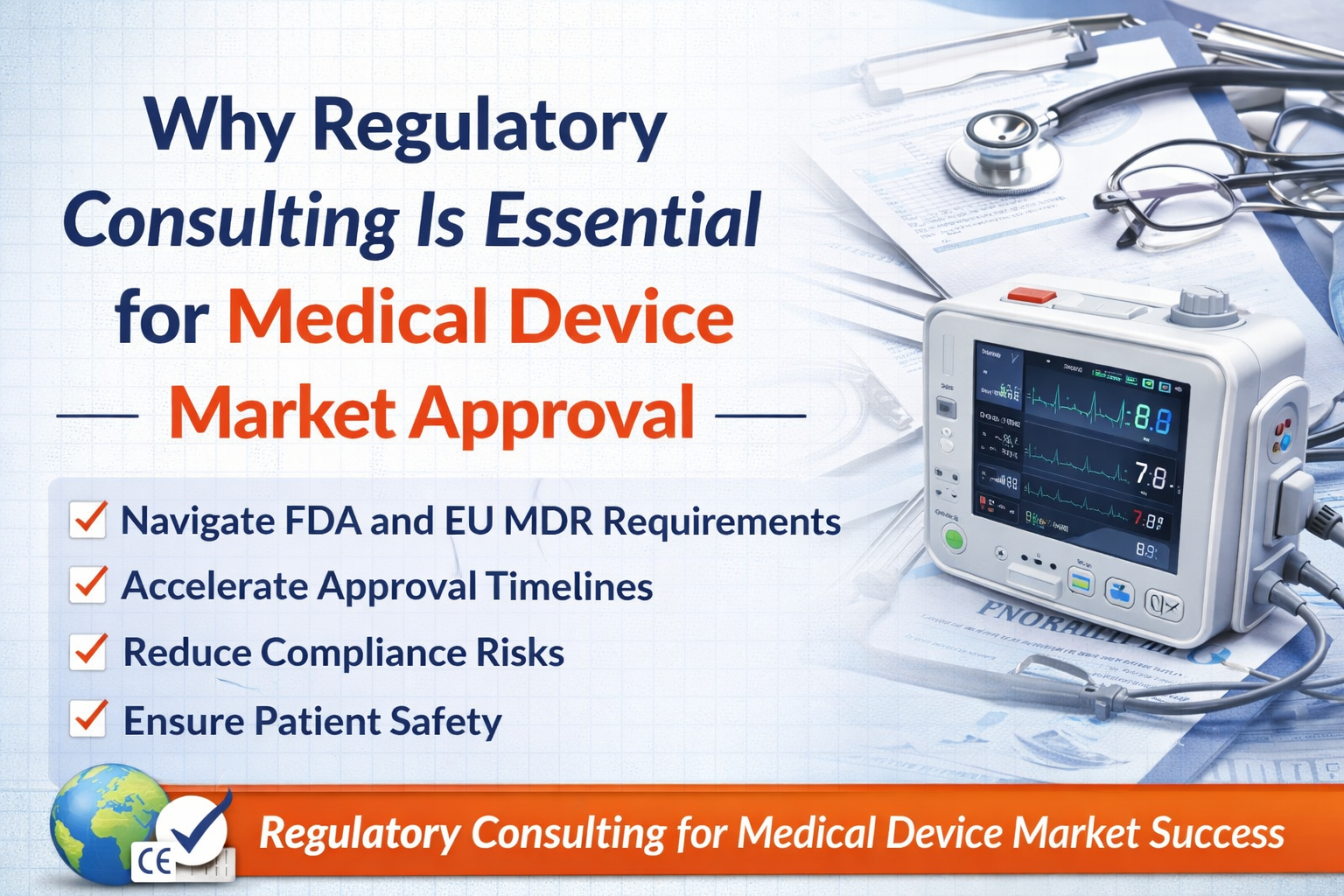
In today’s increasingly complex regulatory environment, partnering with a reliable medical device regulatory consulting company has become a strategic necessity for manufacturers seeking timely and successful market approval. Regulatory requirements in the United States and European Union continue to evolve, placing greater emphasis on clinical evidence, risk management, technical documentation, and post-market compliance. Without a clear regulatory strategy, even innovative and well-designed devices can face costly delays, repeated deficiency letters, or outright rejection. Regulatory consulting bridges the gap between product innovation and regulatory expectations, enabling manufacturers to navigate approval pathways with confidence.
Medical Device Regulatory Consulting
Medical device regulatory consulting involves providing expert guidance on how to comply with national and international regulatory requirements throughout the product lifecycle. Consultants help manufacturers interpret regulations, select appropriate approval pathways, and prepare compliant documentation. Their role is not limited to submission preparation; they support strategic planning, risk management integration, and post-market obligations.
As regulatory frameworks such as FDA Quality System Regulation (QSR) and EU Medical Device Regulation (MDR) become more stringent, internal teams often struggle to keep pace. Regulatory consultants bring specialized knowledge and practical experience that reduce uncertainty and improve decision-making.
Understanding the Medical Device Regulatory Landscape
The regulatory environment for medical devices differs by region, but all authorities share a common goal: ensuring patient safety and device effectiveness.
In the United States, manufacturers typically pursue one of three main pathways:
- 510(k) for devices demonstrating substantial equivalence
- De Novo for novel, low-to-moderate risk devices
- Premarket Approval (PMA) for high-risk devices
In the European Union, manufacturers must comply with EU MDR to obtain CE marking. This involves classification-based conformity assessment, technical documentation review, and ongoing post-market surveillance.
Understanding these pathways is critical. Selecting the wrong route or misunderstanding evidence expectations can lead to extended review cycles and additional data requests.
What Regulatory Consulting Covers
Regulatory consulting services typically span multiple functional areas, including:
- Regulatory strategy and pathway selection
- Technical documentation and submission preparation
- Clinical evaluation and evidence planning
- Risk management integration
- Quality system alignment
- Post-market surveillance and vigilance
By addressing compliance holistically, consultants ensure that all regulatory activities support each other rather than operating in silos.
How Regulatory Consulting Supports Faster Market Approval
One of the biggest advantages of regulatory consulting is reduced time-to-market. Consultants help manufacturers avoid common submission errors such as missing documents, inconsistent data, or unclear justifications. They also ensure that submissions align with regulatory guidance and reviewer expectations.
A well-defined regulatory strategy minimizes back-and-forth communication with authorities and reduces the likelihood of major deficiencies. This proactive approach often translates into faster reviews and fewer surprises.
Role of Regulatory Consulting in Risk Management and Compliance
Risk management is central to regulatory approval. Consultants support alignment with ISO 14971 and help integrate risk management outputs into design controls, clinical evaluation, and labeling.
When risk management is properly linked to regulatory documentation, manufacturers can clearly demonstrate that hazards have been identified, evaluated, and controlled. This traceability is a key expectation for both FDA and EU MDR reviewers.
Regulatory Consulting Across the Product Lifecycle
Regulatory consulting provides value at every stage of product development:
Early Development
Consultants help define regulatory strategy and evidence requirements before design is finalized.
Design and Verification
They ensure design controls, verification, and validation activities meet regulatory standards.
Pre-Market Submission
Consultants prepare and review submission dossiers to ensure completeness and consistency.
Post-Market Phase
They support surveillance planning, complaint handling, and regulatory reporting.
This lifecycle approach prevents compliance gaps from emerging later.
Benefits of Using Regulatory Consulting Services
Engaging regulatory consultants offers several tangible benefits:
- Higher probability of approval success
- Reduced rework and submission delays
- Improved documentation quality
- Clear regulatory roadmap
- Better internal resource utilization
Manufacturers pursuing global commercialization often rely on regulatory affairs consulting medical device development services to coordinate requirements across multiple markets.
Common Regulatory Challenges Without Expert Support
Organizations attempting to manage regulatory activities alone often face:
- Incorrect pathway selection
- Incomplete or inconsistent documentation
- Weak clinical evidence justification
- Misalignment between risk management and clinical data
- Post-market compliance gaps
These issues can lead to costly remediation and lost market opportunities.
When Should Manufacturers Engage Regulatory Consultants?
Ideally, regulatory consulting should begin during early concept development. However, consultants also add value when:
- Entering a new geographic market
- Developing novel technologies
- Updating legacy devices to new regulations
- Responding to regulatory deficiencies
Early engagement prevents downstream problems.
Regulatory Consulting for FDA vs EU MDR Approvals
Although FDA and EU MDR share similar safety objectives, their approaches differ. EU MDR places greater emphasis on clinical evaluation and post-market clinical follow-up, while FDA focuses heavily on substantial equivalence and benefit–risk determination.
Manufacturers seeking CE marking often require specialized CE Marking consulting for medical devices to meet EU-specific documentation and conformity assessment expectations.
Choosing the Right Regulatory Consulting Partner
When selecting a regulatory consulting partner, manufacturers should evaluate:
- Industry experience and therapeutic area expertise
- Knowledge of applicable regulations
- Track record with successful submissions
- Communication and project management approach
A strong partner functions as an extension of the internal team.
Conclusion
Regulatory consulting is no longer a luxury—it is a strategic investment that directly impacts market access and business success. By working with a trusted medical device regulatory consulting company, manufacturers can navigate complex regulations, reduce compliance risk, and accelerate approvals while maintaining high standards of safety and quality.
FAQs
Is regulatory consulting mandatory?
No, but it significantly improves compliance and approval success.
Can consultants interact with regulatory authorities?
Yes, many support agency meetings and responses.
How early should regulatory consulting start?
Ideally during early development.
Does regulatory consulting reduce approval timelines?
In most cases, yes, by minimizing errors and rework.