
In today’s increasingly complex regulatory environment, partnering with a reliable medical device regulatory consulting company has become a strategic necessity for manufacturers seeking timely and successful market approval. Regulatory requirements in the United States and European Union continue to evolve, placing greater emphasis on clinical evidence, risk management, technical documentation, and post-market compliance. Without a clear regulatory strategy, even innovative and well-designed devices can face costly delays, repeated deficiency letters, or outright rejection. Regulatory consulting bridges the gap between product innovation and regulatory expectations, enabling manufacturers to navigate approval pathways with confidence. Medical Device Regulatory Consulting Medical device regulatory consulting involves providing expert guidance on how to comply with national and international regulatory requirements throughout the product lifecycle. Consultants help manufacturers interpret regulations, select appropriate approval pathways, and prepare compliant documentation. Their role is not limited to submission preparation; they support strategic planning, risk management integration, and post-market obligations. As regulatory frameworks such as FDA Quality System Regulation (QSR) and EU Medical Device Regulation (MDR) become more stringent, internal teams often struggle to keep pace. Regulatory consultants bring specialized knowledge and practical experience that reduce uncertainty and improve decision-making. Understanding the Medical Device Regulatory Landscape The regulatory environment for medical devices differs by region, but all authorities share a common goal: ensuring patient safety and device effectiveness. In the United States, manufacturers typically pursue one of three main pathways: 510(k) for devices demonstrating substantial equivalence De Novo for novel, low-to-moderate risk devices Premarket Approval (PMA) for high-risk devices In the European Union, manufacturers must comply with EU MDR to obtain CE marking. This involves classification-based conformity assessment, technical documentation review, and ongoing post-market surveillance. Understanding these pathways is critical. Selecting the wrong route or misunderstanding evidence expectations can lead to extended review cycles and additional data requests. What Regulatory Consulting Covers Regulatory consulting services typically span multiple functional areas, including: Regulatory strategy and pathway selection Technical documentation and submission preparation Clinical evaluation and evidence planning Risk management integration Quality system alignment Post-market surveillance and vigilance By addressing compliance holistically, consultants ensure that all regulatory activities support each other rather than operating in silos. How Regulatory Consulting Supports Faster Market Approval One of the biggest advantages of regulatory consulting is reduced time-to-market. Consultants help manufacturers avoid common submission errors such as missing documents, inconsistent data, or unclear justifications. They also ensure that submissions align with regulatory guidance and reviewer expectations. A well-defined regulatory strategy minimizes back-and-forth communication with authorities and reduces the likelihood of major deficiencies. This proactive approach often translates into faster reviews and fewer surprises. Role of Regulatory Consulting in Risk Management and Compliance Risk management is central to regulatory approval. Consultants support alignment with ISO 14971 and help integrate risk management outputs into design controls, clinical evaluation, and labeling. When risk management is properly linked to regulatory documentation, manufacturers can clearly demonstrate that hazards have been identified, evaluated, and controlled. This traceability is a key expectation for both FDA and EU MDR reviewers. Regulatory Consulting Across the Product Lifecycle Regulatory consulting provides value at every stage of product development: Early Development Consultants help define regulatory strategy and evidence requirements before design is finalized. Design and Verification They ensure design controls, verification, and validation activities meet regulatory standards. Pre-Market Submission Consultants prepare and review submission dossiers to ensure completeness and consistency. Post-Market Phase They support surveillance planning, complaint handling, and regulatory reporting. This lifecycle approach prevents compliance gaps from emerging later. Benefits of Using Regulatory Consulting Services Engaging regulatory consultants offers several tangible benefits: Higher probability of approval success Reduced rework and submission delays Improved documentation quality Clear regulatory roadmap Better internal resource utilization Manufacturers pursuing global commercialization often rely on regulatory affairs consulting medical device development services to coordinate requirements across multiple markets. Common Regulatory Challenges Without Expert Support Organizations attempting to manage regulatory activities alone often face: Incorrect pathway selection Incomplete or inconsistent documentation Weak clinical evidence justification Misalignment between risk management and clinical data Post-market compliance gaps These issues can lead to costly remediation and lost market opportunities. When Should Manufacturers Engage Regulatory Consultants? Ideally, regulatory consulting should begin during early concept development. However, consultants also add value when: Entering a new geographic market Developing novel technologies Updating legacy devices to new regulations Responding to regulatory deficiencies Early engagement prevents downstream problems. Regulatory Consulting for FDA vs EU MDR Approvals Although FDA and EU MDR share similar safety objectives, their approaches differ. EU MDR places greater emphasis on clinical evaluation and post-market clinical follow-up, while FDA focuses heavily on substantial equivalence and benefit–risk determination. Manufacturers seeking CE marking often require specialized CE Marking consulting for medical devices to meet EU-specific documentation and conformity assessment expectations. Choosing the Right Regulatory Consulting Partner When selecting a regulatory consulting partner, manufacturers should evaluate: Industry experience and therapeutic area expertise Knowledge of applicable regulations Track record with successful submissions Communication and project management approach A strong partner functions as an extension of the internal team. Conclusion Regulatory consulting is no longer a luxury—it is a strategic investment that directly impacts market access and business success. By working with a trusted medical device regulatory consulting company, manufacturers can navigate complex regulations, reduce compliance risk, and accelerate approvals while maintaining high standards of safety and quality. FAQs Is regulatory consulting mandatory? No, but it significantly improves compliance and approval success. Can consultants interact with regulatory authorities? Yes, many support agency meetings and responses. How early should regulatory consulting start? Ideally during early development. Does regulatory consulting reduce approval timelines? In most cases, yes, by minimizing errors and rework.
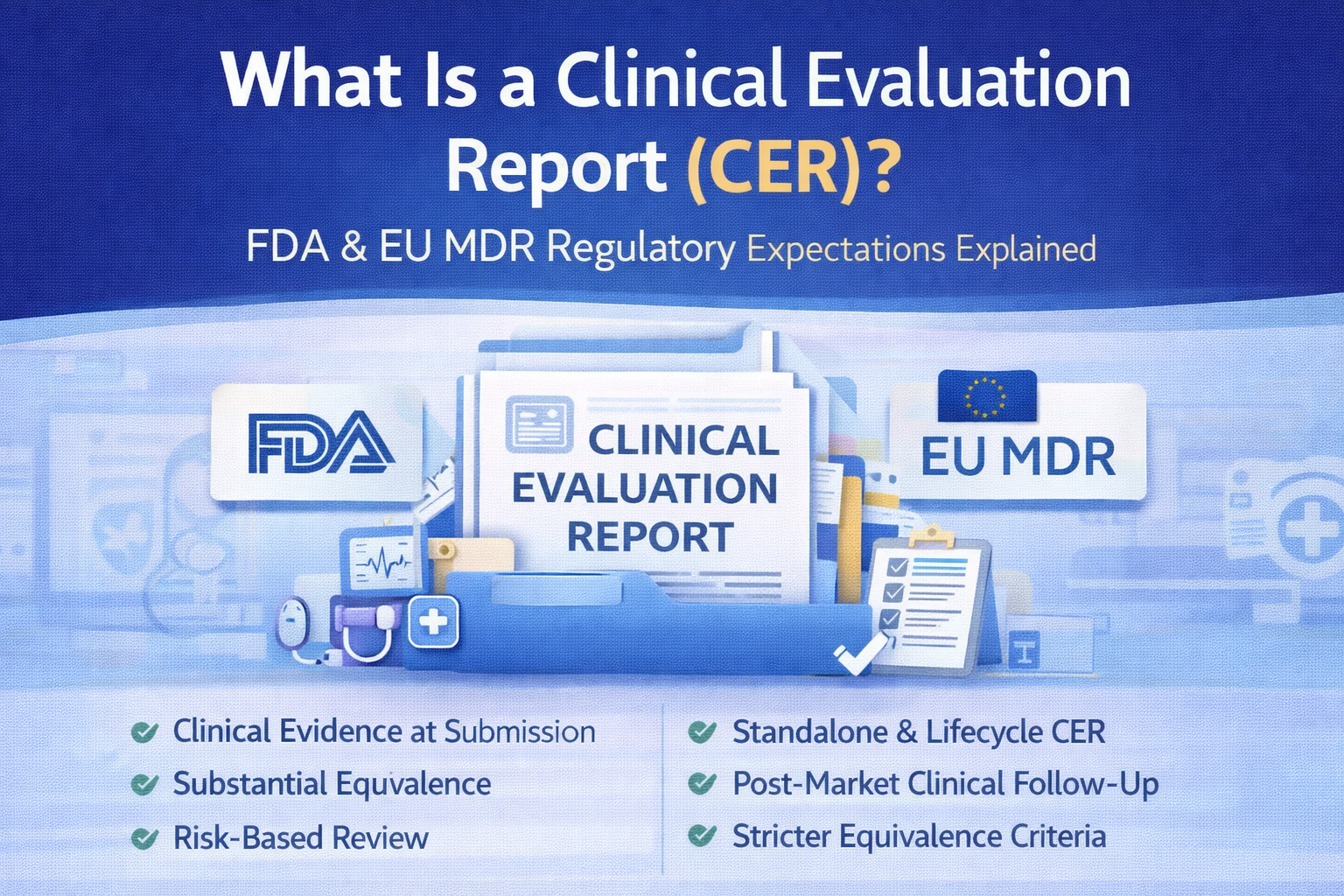
What Is a Clinical Evaluation Report (CER)? FDA & EU MDR Regulatory Expectations Explained
What Is a Clinical Evaluation Report (CER)? FDA & EU MDR Regulatory Expectations Explained In an era of heightened regulatory scrutiny, clinical evaluation report writing has become a cornerstone of medical device compliance for manufacturers operating in the United States and European Union. Regulatory authorities increasingly expect clear, well-documented clinical evidence demonstrating that a device is safe, performs as intended, and delivers measurable clinical benefit. Understanding what a Clinical Evaluation Report (CER) is—and how FDA and EU MDR expectations differ—is critical to avoiding costly regulatory delays and non-compliance findings. This blog explains the purpose, structure, and regulatory expectations of a Clinical Evaluation Report, with practical insights tailored for global medical device and digital health companies. What Is a Clinical Evaluation Report (CER)? A Clinical Evaluation Report is a structured regulatory document that systematically collects, appraises, and analyzes clinical data related to a medical device. Its primary objective is to demonstrate that the device meets applicable safety and performance requirements when used according to its intended purpose. Under the EU Medical Device Regulation (MDR), the Clinical Evaluation Report is a required and integral part of a manufacturer’s technical documentation. In contrast, while the US FDA does not explicitly require a document labeled as a “CER,” the underlying clinical evaluation principles are embedded within FDA premarket and post-market review processes. Regardless of geography, the CER serves as a scientific and regulatory justification for placing and maintaining a medical device on the market. Is a Clinical Evaluation Report Mandatory? CER Requirement Under EU MDR Under EU MDR Article 61 and Annex XIV, manufacturers must conduct and document a clinical evaluation for all medical devices, regardless of class. The regulation emphasizes: Continuous clinical evaluation throughout the device lifecycle Stronger clinical evidence requirements for higher-risk devices Limited reliance on equivalence unless stringent criteria are met Mandatory integration of Post-Market Clinical Follow-Up (PMCF) Notified Bodies review CERs in detail, making them one of the most frequently cited sources of non-conformities during conformity assessments. CER Expectations Under FDA Regulations In the US, the FDA evaluates clinical evidence as part of regulatory submissions such as: 510(k) (substantial equivalence) De Novo (novel, low-to-moderate risk devices) Premarket Approval (PMA) (high-risk devices) Although the FDA does not require a standalone CER, manufacturers often prepare CER-style documentation internally to support regulatory strategy, risk assessment, and benefit–risk justification. FDA vs EU MDR: Key Differences in Clinical Evaluation Expectations While both regulatory systems prioritize patient safety, their approaches differ: EU MDR requires a formal, standalone CER maintained throughout the product lifecycle FDA assesses clinical evidence primarily at submission and post-market review stages EU MDR places greater emphasis on post-market data and PMCF FDA focuses on substantial equivalence and risk-based evidence requirements Understanding these differences is essential for companies pursuing dual-market approvals. When Is Clinical Data Required for Regulatory Submissions? Clinical data may be required in both regions depending on: Device classification and risk profile Novelty of technology Availability of existing clinical evidence Intended use and patient population Acceptable clinical data sources include published literature, clinical investigations, registries, real-world evidence, and post-market surveillance data. Regulators expect manufacturers to justify the relevance, quality, and sufficiency of all clinical data used. Core Elements of a Clinical Evaluation Report A compliant Clinical Evaluation Report typically includes: Device description and intended purpose Clinical background and state-of-the-art analysis Identification of relevant clinical data Critical appraisal of clinical evidence Clinical data analysis and benefit–risk assessment Clear regulatory conclusions Each element must be consistent with the device’s risk management file, usability engineering, and quality management system documentation. Clinical Evaluation Report vs Clinical Study: Regulatory Clarification A common misconception is that a CER is the same as a clinical study. In reality: A clinical study generates new clinical data A Clinical Evaluation Report analyzes existing and newly generated data Clinical investigations may be required when existing evidence is insufficient. Results from clinical studies are then incorporated into the CER to support regulatory conclusions. Common FDA and Notified Body Deficiencies in CERs Regulatory reviewers frequently identify deficiencies such as: Inadequate or outdated clinical evidence Poorly defined literature search methodology Weak equivalence justification Lack of alignment with post-market surveillance data Inconsistent benefit–risk analysis Many of these issues arise when manufacturers treat CERs as static documents rather than living regulatory tools. How Often Should a Clinical Evaluation Report Be Updated? Update frequency depends on device classification and risk: Class I and Class IIa devices: Clinical Evaluation Reports should be reviewed and updated at defined intervals or whenever significant design, clinical, or safety changes occur. Class IIb and Class III devices: CERs should be updated at least annually or in alignment with Periodic Safety Update Report (PSUR) review cycles. Trigger events include design modifications, safety signals, new clinical data, regulatory changes, or increased adverse event trends. A proactive update strategy significantly reduces regulatory risk. Best Practices to Meet FDA & EU MDR Clinical Evaluation Expectations To ensure robust compliance: Align CER activities with ISO 14155 and ISO 14971 Maintain traceability across CER, PMS, PMCF, and risk management Use a documented methodology for literature reviews and data appraisal Treat clinical evaluation as an ongoing process Many manufacturers now adopt integrated clinical evaluation plan & report writing approaches to ensure consistency between planning, execution, and regulatory documentation. Conclusion: Why Understanding CER Expectations Matters A clear understanding of Clinical Evaluation Report expectations under both FDA and EU MDR frameworks enables medical device and digital health companies to reduce regulatory uncertainty, accelerate approvals, and maintain long-term compliance. By investing in structured processes, high-quality evidence appraisal, and expert-led clinical evaluation report writing, manufacturers can confidently meet global regulatory demands while supporting patient safety and innovation. Frequently Asked Questions (FAQs) 1. What is the purpose of a Clinical Evaluation Report (CER)? A Clinical Evaluation Report (CER) demonstrates that a medical device is safe, performs as intended, and delivers clinical benefit throughout its lifecycle. It provides regulators with structured clinical evidence supporting conformity with EU MDR and FDA regulatory expectations. 2. Is a Clinical Evaluation Report mandatory under EU MDR? Yes. Under EU

How to Build an FDA-Compliant Medical Device Risk Management Plan Under ISO 14971: A U.S. Regulatory Guide
How to Build an FDA-Compliant Medical Device Risk Management Plan Under ISO 14971: A U.S. Regulatory Guide A well-structured medical device risk management plan has become essential for achieving FDA clearance, De Novo classification, or PMA approval. As U.S. regulatory expectations continue to evolve, the FDA is placing stronger emphasis on benefit–risk analysis, traceability, and lifecycle safety. For manufacturers developing traditional medical devices, connected products, or software as a medical device (SaMD), demonstrating a consistent and evidence-driven risk management approach is now a critical component of submission readiness. Why Risk Management Is Crucial for FDA Submissions Today’s U.S. regulatory environment demands greater transparency around how manufacturers identify hazards, evaluate potential harm, and ensure patient and user safety. The FDA expects risk management activities to span the entire product lifecycle—from concept and design through manufacturing, market launch, and ongoing surveillance. How FDA Regulations Influence Risk Management Expectations The FDA does not prescribe a single mandatory template for risk documents. Instead, risk management is woven into several parts of the Quality System Regulation (QSR): 1. 21 CFR 820.30 — Design Controls FDA reviewers expect risk analysis to influence: Design input requirements Verification and validation (V&V) Design review discussions Final design outputs 2. 21 CFR 820.100 — Corrective and Preventive Actions CAPA processes must incorporate risk-based decision-making and link back to identified hazards and risk control measures. 3. 21 CFR 803 — Medical Device Reporting (MDR) Adverse events, malfunctions, and device-related injuries directly feed into ongoing risk evaluation and updates. Together, these regulations reinforce the FDA’s expectation that risk management is a continuous activity—not a one-time checklist. Step-by-Step Guide to Creating a FDA-Ready Risk Management Plan 1. Define Intended Use, Indications, and User Group A strong risk analysis begins with clarity about the product’s purpose, target population, healthcare setting, and user profile. Many FDA deficiencies arise when intended use and risk files do not align. 2. Establish the Scope and Objectives Your risk management plan should: Cover the full lifecycle Define risk acceptance criteria Specify hazard categories Create consistent scoring methods Clarify documentation requirements This becomes the roadmap for all subsequent risk activities. 3. Assemble a Cross-Functional Risk Team Effective risk management relies on experts from: R&D Clinical affairs Regulatory Cybersecurity Quality & manufacturing Usability / human factors engineering Competency documentation may be requested during FDA inspections. 4. Identify Hazards and Hazardous Situations Common categories include: Mechanical, electrical, and thermal risks Biological and chemical hazards Usability-related risks Software and cybersecurity vulnerabilities Data integrity and algorithmic issues for SaMD Identifying foreseeable misuse is equally important. 5. Conduct Detailed Risk Analysis Manufacturers must evaluate severity, probability, and detectability using proven methods such as: FMEA Hazard analysis (HA) Fault tree analysis (FTA) Software hazard analysis FDA reviewers expect traceability between hazards and design outputs, testing methods, and labeling. 6. Implement Risk Control Measures Risk controls must go beyond listing hazards—they must be executed and verified. Controls may include: Inherent design modifications Protective features Alarms, warnings, or software safeguards Instructions for use (IFU) and training Verification evidence is crucial for proving control effectiveness. 7. Evaluate Residual Risk Residual risk must be: Quantified Scientifically justified Reviewed during design reviews Balanced against clinical benefits FDA may request benefit–risk justification if residual risks remain high. 8. Maintain Full Traceability Traceability remains one of the most common FDA deficiencies. Every hazard must link to: Risk scoring Control measures Verification results Residual risk evaluation Labeling or training content A centralized, audit-ready file is essential for compliance. Risk Management and FDA Design Controls: The Critical Link FDA expects risk analysis to guide key design control elements, including: Design input creation Risk-based verification protocols Validation aligned with real-world use Engineering/design reviews Devices with strong design control–risk management integration typically face fewer regulatory roadblocks. U.S. vs. EU Expectations: What Global Manufacturers Should Know Even though this guide centers on U.S. regulations, most companies optimize risk management for dual compliance. Key differences: EU MDR demands ongoing lifecycle updating of risk files. Annex I connects risk directly to clinical evidence and PMCF. PMS and risk management must align with CER updates. A harmonized global risk strategy reduces rework and inconsistencies. Many organizations collaborate with specialists experienced in risk management medical device programs to meet modern regulatory requirements. Partnering with a medical device development company can also strengthen hazard analysis, usability engineering, and SaMD cybersecurity planning while aligning documentation with FDA expectations. Common Risk Management Errors in U.S. Submissions Manufacturers frequently struggle with: Poorly defined intended use Missing or weak post-market data No justification for residual risks Incomplete hazard-to-verification traceability Neglecting usability or cybersecurity risks Addressing these gaps early reduces FDA review delays. Best Practices for an Audit-Ready Risk Management File To ensure long-term compliance: Start risk activities early, during concept design Maintain centralized traceability Use consistent scoring criteria Conduct internal reviews throughout development Update risk files after design changes or post-market findings Link risk records to CAPA, complaints, and PMS Conclusion Building a robust, FDA-aligned risk framework requires structured planning, cross-functional collaboration, and continuous lifecycle maintenance. A strong medical device risk management plan not only improves approval timelines—it enhances device safety, strengthens market confidence, and supports long-term U.S. and EU regulatory compliance. Frequently Asked Questions (FAQs) Does the FDA require ISO 14971 compliance? Not formally, but FDA reviewers strongly favor submissions aligned with ISO 14971 methodology. What risk documents are typically required for 510(k) submissions? Hazard analysis, risk management plan, risk evaluation, residual risk justification, and traceability linked to design controls. How often should risk files be updated? Continuously—especially after design updates, complaints, CAPA actions, or post-market safety signals. What tools help manage risk effectively? FMEA software, design control management tools, cybersecurity assessment platforms, and complaint analysis systems.

Clinical Evaluation Report vs. Clinical Study Report: What U.S. Regulatory Teams Should Know
Clinical Evaluation Report vs. Clinical Study Report: What U.S. Regulatory Teams Should Know For medical device manufacturers seeking FDA clearance or EU MDR compliance, understanding the difference between a Clinical Evaluation Report (CER) and Clinical Study Report (CSR) is essential. These two documents support regulatory submissions in different ways, yet many teams mistakenly treat them as interchangeable. As regulatory expectations evolve, especially in markets preparing for stricter post-market surveillance and lifecycle documentation, strong clinical evaluation report writing practices are becoming a core compliance requirement rather than an administrative task. What Is a Clinical Evaluation Report (CER)? A Clinical Evaluation Report is a structured document that evaluates clinical data to demonstrate a device’s safety, performance, and intended use claims. Under EU MDR, creating and maintaining a CER is mandatory for nearly all device classes. While the FDA does not require a CER in the same standardized format, manufacturers still must provide scientifically valid evidence to support substantial equivalence (510(k)), safety and effectiveness (PMA), or benefit-risk justification (De Novo). A CER typically includes: Device intended purpose and regulatory classification Current clinical background and state-of-the-art analysis Literature review and appraisal methodology Real-world evidence such as registry data, post-market data, or user feedback Benefit-risk summary aligned with clinical claims The document must also link to post-market surveillance activities, post-market clinical follow-up plans, usability studies, and risk management documentation to ensure lifecycle compliance. What Is a Clinical Study Report (CSR)? A Clinical Study Report presents results from a clinical investigation performed under Good Clinical Practice (GCP), such as ISO 14155 for medical devices. A CSR is evidence-based and contains statistical analysis, methodology, patient outcomes, safety summaries, and conclusions derived from clinical trials. CSRs are often required when: Substantial equivalence cannot be demonstrated A novel or high-risk device is being submitted FDA or EU notified bodies require clinical trial evidence Post-market clinical follow-up studies generate new performance data Unlike a CER, which summarizes a broad range of evidence, a CSR focuses exclusively on clinical study findings. Key Differences: CER vs. CSR While both documents support regulatory submissions, their roles and use cases differ: A CER summarizes the totality of available evidence—published literature, real-world performance data, and clinical studies. A CSR documents a single clinical investigation conducted under a defined protocol. CERs are updated throughout the product lifecycle, especially under EU MDR. CSRs are typically produced at the end of a clinical trial and are not routinely updated unless the study is extended or repeated. Understanding the relationship between these two documents helps prevent costly submission delays, inconsistencies, and regulatory feedback cycles. How CER and CSR Work Together CSR data can strengthen the CER, especially where literature or real-world evidence is limited. For innovative or higher-risk devices, notified bodies and FDA reviewers expect alignment between CSR outcomes, intended use claims, labeling, and the risk-benefit justification in the CER. This alignment becomes even more critical when integrating other compliance files such as PMS plans, performance evaluations, and the clinical evaluation plan & report writing framework used for MDR documentation. Regulatory Expectations in the U.S. and EU In the United States, the FDA may request CSR outputs as part of a clinical section, especially for PMA devices, but the evaluation format is flexible. In contrast, the European MDR requires a CER in a structured format with defined methodology and lifecycle update requirements. For companies selling in both regions, regulatory teams must harmonize documentation strategies to prevent duplication, reduce rework, and maintain consistency across global markets. Common Mistakes and Compliance Risks Many organizations struggle with: Using outdated MEDDEV-based formats not aligned with MDR Lack of systematic literature methodology Weak or unsubstantiated equivalence arguments Misalignment between risk documentation and CER conclusions Insufficient post-market data to support claims These gaps not only trigger audit findings but can also delay approvals, impact renewals, or jeopardize certification. Best Practices for Regulatory Teams To ensure efficiency and compliance: Develop evidence strategies early in product development Treat the CER as a living regulatory document Use validated literature review tools and structured appraisal methods Maintain cross-functional collaboration across Regulatory, QA, Clinical Affairs, and R&D Consider CE Marking consulting for medical devices when entering EU markets or revising legacy CERs Organizations that follow structured workflows often reduce submission delays, cost overruns, and compliance risks. When Outsourcing Makes Sense If internal teams lack regulatory expertise, time, or literature research capability, outsourcing CER or CSR development can be a valuable solution. Experienced writers ensure alignment with FDA expectations, MDR Annex XIV, ISO 14155, ISO 14971, and PMS requirements. Conclusion Understanding the difference between a CER and CSR—and how they work together—is essential for maintaining compliance, supporting regulatory submissions, and building defensible evidence strategies across global markets. As requirements evolve, investing in accurate, structured, and compliant clinical evaluation report writing practices is key to securing faster approvals, smoother audits, and long-term lifecycle regulatory success. Frequently Asked Questions Is a Clinical Evaluation Report required for FDA submissions? Not in the EU MDR format, but the FDA still requires evidence that supports device claims and safety. Do all medical devices need a Clinical Study Report? No. CSRs are required only when clinical investigations are conducted. How often must a CER be updated under MDR? Update frequency varies based on device classification and post-market findings. Can a CER be approved without clinical study data? Sometimes—but only when robust literature and post-market data sufficiently support safety and performance. Should companies outsource CER or CSR writing? Many organizations do, especially when entering EU markets or lacking internal expertise.