
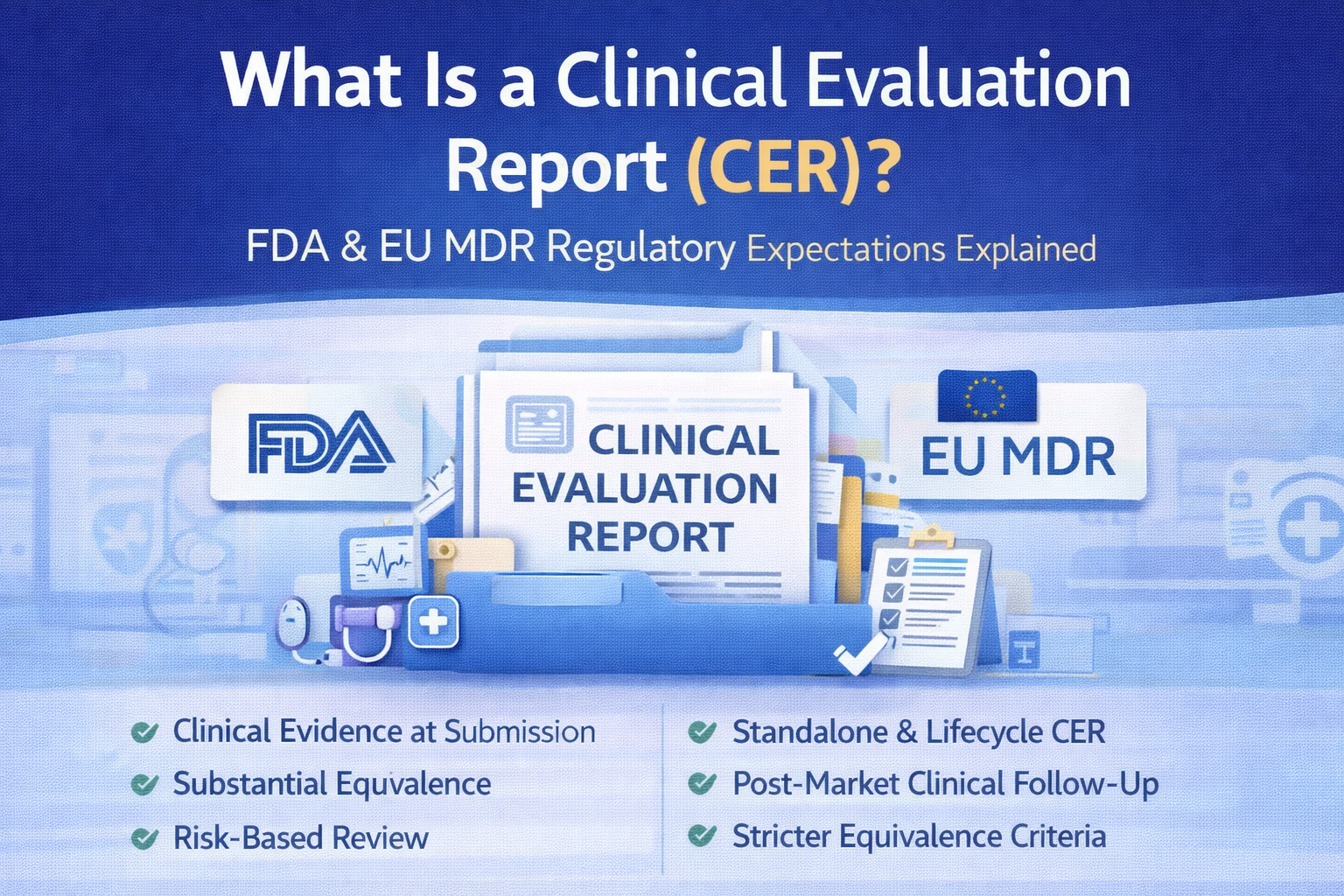
What Is a Clinical Evaluation Report (CER)? FDA & EU MDR Regulatory Expectations Explained In an era of heightened regulatory scrutiny, clinical evaluation report writing has become a cornerstone of medical device compliance for manufacturers operating in the United States and European Union. Regulatory authorities increasingly expect clear, well-documented clinical evidence demonstrating that a device is safe, performs as intended, and delivers measurable clinical benefit. Understanding what a Clinical Evaluation Report (CER) is—and how FDA and EU MDR expectations differ—is critical to avoiding costly regulatory delays and non-compliance findings. This blog explains the purpose, structure, and regulatory expectations of a Clinical Evaluation Report, with practical insights tailored for global medical device and digital health companies. What Is a Clinical Evaluation Report (CER)? A Clinical Evaluation Report is a structured regulatory document that systematically collects, appraises, and analyzes clinical data related to a medical device. Its primary objective is to demonstrate that the device meets applicable safety and performance requirements when used according to its intended purpose. Under the EU Medical Device Regulation (MDR), the Clinical Evaluation Report is a required and integral part of a manufacturer’s technical documentation. In contrast, while the US FDA does not explicitly require a document labeled as a “CER,” the underlying clinical evaluation principles are embedded within FDA premarket and post-market review processes. Regardless of geography, the CER serves as a scientific and regulatory justification for placing and maintaining a medical device on the market. Is a Clinical Evaluation Report Mandatory? CER Requirement Under EU MDR Under EU MDR Article 61 and Annex XIV, manufacturers must conduct and document a clinical evaluation for all medical devices, regardless of class. The regulation emphasizes: Continuous clinical evaluation throughout the device lifecycle Stronger clinical evidence requirements for higher-risk devices Limited reliance on equivalence unless stringent criteria are met Mandatory integration of Post-Market Clinical Follow-Up (PMCF) Notified Bodies review CERs in detail, making them one of the most frequently cited sources of non-conformities during conformity assessments. CER Expectations Under FDA Regulations In the US, the FDA evaluates clinical evidence as part of regulatory submissions such as: 510(k) (substantial equivalence) De Novo (novel, low-to-moderate risk devices) Premarket Approval (PMA) (high-risk devices) Although the FDA does not require a standalone CER, manufacturers often prepare CER-style documentation internally to support regulatory strategy, risk assessment, and benefit–risk justification. FDA vs EU MDR: Key Differences in Clinical Evaluation Expectations While both regulatory systems prioritize patient safety, their approaches differ: EU MDR requires a formal, standalone CER maintained throughout the product lifecycle FDA assesses clinical evidence primarily at submission and post-market review stages EU MDR places greater emphasis on post-market data and PMCF FDA focuses on substantial equivalence and risk-based evidence requirements Understanding these differences is essential for companies pursuing dual-market approvals. When Is Clinical Data Required for Regulatory Submissions? Clinical data may be required in both regions depending on: Device classification and risk profile Novelty of technology Availability of existing clinical evidence Intended use and patient population Acceptable clinical data sources include published literature, clinical investigations, registries, real-world evidence, and post-market surveillance data. Regulators expect manufacturers to justify the relevance, quality, and sufficiency of all clinical data used. Core Elements of a Clinical Evaluation Report A compliant Clinical Evaluation Report typically includes: Device description and intended purpose Clinical background and state-of-the-art analysis Identification of relevant clinical data Critical appraisal of clinical evidence Clinical data analysis and benefit–risk assessment Clear regulatory conclusions Each element must be consistent with the device’s risk management file, usability engineering, and quality management system documentation. Clinical Evaluation Report vs Clinical Study: Regulatory Clarification A common misconception is that a CER is the same as a clinical study. In reality: A clinical study generates new clinical data A Clinical Evaluation Report analyzes existing and newly generated data Clinical investigations may be required when existing evidence is insufficient. Results from clinical studies are then incorporated into the CER to support regulatory conclusions. Common FDA and Notified Body Deficiencies in CERs Regulatory reviewers frequently identify deficiencies such as: Inadequate or outdated clinical evidence Poorly defined literature search methodology Weak equivalence justification Lack of alignment with post-market surveillance data Inconsistent benefit–risk analysis Many of these issues arise when manufacturers treat CERs as static documents rather than living regulatory tools. How Often Should a Clinical Evaluation Report Be Updated? Update frequency depends on device classification and risk: Class I and Class IIa devices: Clinical Evaluation Reports should be reviewed and updated at defined intervals or whenever significant design, clinical, or safety changes occur. Class IIb and Class III devices: CERs should be updated at least annually or in alignment with Periodic Safety Update Report (PSUR) review cycles. Trigger events include design modifications, safety signals, new clinical data, regulatory changes, or increased adverse event trends. A proactive update strategy significantly reduces regulatory risk. Best Practices to Meet FDA & EU MDR Clinical Evaluation Expectations To ensure robust compliance: Align CER activities with ISO 14155 and ISO 14971 Maintain traceability across CER, PMS, PMCF, and risk management Use a documented methodology for literature reviews and data appraisal Treat clinical evaluation as an ongoing process Many manufacturers now adopt integrated clinical evaluation plan & report writing approaches to ensure consistency between planning, execution, and regulatory documentation. Conclusion: Why Understanding CER Expectations Matters A clear understanding of Clinical Evaluation Report expectations under both FDA and EU MDR frameworks enables medical device and digital health companies to reduce regulatory uncertainty, accelerate approvals, and maintain long-term compliance. By investing in structured processes, high-quality evidence appraisal, and expert-led clinical evaluation report writing, manufacturers can confidently meet global regulatory demands while supporting patient safety and innovation. Frequently Asked Questions (FAQs) 1. What is the purpose of a Clinical Evaluation Report (CER)? A Clinical Evaluation Report (CER) demonstrates that a medical device is safe, performs as intended, and delivers clinical benefit throughout its lifecycle. It provides regulators with structured clinical evidence supporting conformity with EU MDR and FDA regulatory expectations. 2. Is a Clinical Evaluation Report mandatory under EU MDR? Yes. Under EU